Tuesday, March 14, 2023

Rochester Chess Center Proudly Presents: The 17th Annual Women's Invitational and Brittany Broan Memorial


Tournament Results:


1st: Arianna Kharroubi
2nd: Victoria Yao
3rd: Eleanor Langlois
4th: Emma Pulvino
Top Adult: Anna Tschopp
Top K-12: Anna Borrelli
Top K-4: Eleanor Eckert


                                                                Tournament Flyer:

This is our seventeenth annual all-female chess tournament.  It is being staged to celebrate the women who opened doors in this male-dominated sport and to encourage all those who follow in their footsteps to support and mentor other women.  To help promote this role-modeling, this tournament is open to women of all ages.

Who: Open to women of all ages

    Sections: K-4, K-12, and adult (Sections may be combined depending on number of players)

Awards: 

Trophies for all three sections.  

All participants receive commemorative medal.  

Top overall award: onyx chess set and board.

When: On-site registration runs from 8:30am-9:15am; games start at 9:30; break at 12:00; two or three rounds follow with awards to be presented around 3:30pm.

Where: Rochester Chess Center, 221 Norris Dr., Rochester, NY 14610 (near Cobbs Hill Park).

Entry Fees: $8 by Thursday before event (3/16); $12 same day/onsite. 50% discount for any participants in this year's Interscholastic Chess Leagues, or members of the Rochester Chess Center (individual or family).

For more information, call Ron Lohrman at (585) 442-2430 OR send an e-mail to chesscenter@rochester.rr.com


Monday, February 20, 2023

USATE Rounds 1-2

The US Amateur Team East was held over three days from February 18-20, 2023 in Parsippany, NJ. I usually try to make it each year; in the past I have played some remarkably crazy games at this event.

My first two games were pretty easy wins against lower rated players. Let's see what we can learn from them before moving on to the next two rounds.

Paciorkowski, Lev (2422) - Wang, Yuan (2066)
US Amateur Team East, Parsippany, NJ (Rd. 1)
40/100 SD 30 d5

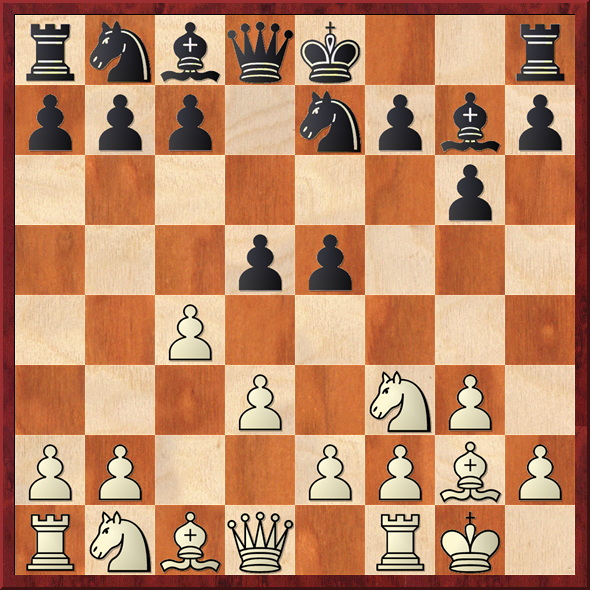
1.e4 I had actually found my opponent's chess.com account a few minutes before the game started, and I saw that he played the Sicilian and might not know what to do against the Nc3-Bb5 line, hence my unusual (for me) opening choice. 1. ... c5 2.Nc3 Nc6 3.Bb5 Nd4 4.Nf3 g6?! (D)

As we have already seen in my game against William Graif, this move is already inaccurate for black! I made the same mistake myself and fortunately my opponent did not properly take advantage. Here I had learned from my own mistake to now be able to play the most testing continuation for white. I think black should instead play 4. ... a6!, which equalizes as far as I can tell.

5.Bc4! It's a crude move - white just wants to attack f7 with Qf3 in a couple moves, but because black is underdeveloped it turns out he will have to make some concession to stop mate. 5. ... Bg7 6.Nxd4 cxd4 7.Qf3 (D) Here my opponent had a long think.

Although this is already suboptimal for black, it is still playable. After some post-game analysis, I think black's best bet is 7. ... Nf6 8.e5 (white's point) dxc3 9.dxc3! (stronger than taking on f6 straightaway) and now very importantly 9. ... Qb6! (9. ... 0-0? 10.exf6 Bxf6 11.Bh6 Bg7 12.Bxg7 Kxg7 13.0-0-0 +/- is great for white) 10.exf6 Qxf6 11.Qe2 0-0 12.Be3 d6 13.h4 h5 and black is close to equality here.

The devious trap that I very well could have fallen into is 7. ... e6 8.Nb5 d6? 9.Qa3! when white is already nearly winning. This line is actually somewhat playable for black if he instead sacrifices a pawn with 8. ... d5! 9.exd5 a6 10.dxe6 fxe6 11.Na3 Nf6 when there is definitely compensation, although it shouldn't quite be enough for a full pawn.

Instead, my opponent played 7. ... Nh6, but now white has an easy advantage because this knight is horribly placed here. 8.Ne2 0-0 9.d3 Hinting at taking on h6 and then on d4. 9. ... Qb6 (D)


Here's an instructive moment. I played my next move without really thinking all that much, but I didn't properly appreciate how big white's advantage is just by playing slowly and trying to round up the d4 pawn. Consider this: 10.h3 Kh8 (black has to try and get the knight back into play) 11.0-0 d6 12.Qg3 Ng8 13.a4 a5 14.f4 e6 15.Qf2! Ne7 16.b3 Bd7 17.Bb2 Nc6 18.Bb5! and black is hard pressed to avoid losing material.

Instead, I played the tempting 10.h4!? black has a strong defensive counter which we both overlooked. 10. ... d6? The only way to stay in the game was 10. ... Ng4!, which we both missed. The point of course is 11.Qxg4 d5, and on 11.h5 Ne5 black eliminates the important light squared bishop and should be doing OK, although the position is still messy. After my opponent's move, white just has a decisive attacking position.

11.h5 Ng4 12.hxg6 hxg6 13.Bb3 a5 14.a4 Bd7 15.Qg3 Qc5 There's really no way to hold the kingside together - I just have too many pieces pointing in that direction. 16.Nf4 The g6 pawn is indefensible. 16. ... Nf6 17.Nxg6 Rfe8 (D)


Of course any move should win here. I finished the game in style: 18.Nh8 Kf8 19.Nxf7 d5 20.Ne5 1-0

Let's have a look at round 2.

Abdi, Farzad (2261) - Paciorkowski, Lev (2422)
US Amateur Team East, Parsippany, NJ (Rd. 2)
40/100 SD 30 d5

Here my opponent is a slightly higher rated player around master level. 1.e4 c5 2.Nf3 Nc6 3.d4 cxd4 4.Nxd4 e5 Lately I've been experimenting around with the Kalashnikov Sicilian... 5.Nb5 d6 6.c4 Be6 (D) We are following a trendy line that has recently become popular for black. Traditionally, black would play ...Be7 and go for f7-f5 later.


The main line is now 7.N1c3, when we reach an important tabiya position after 7. ... a6 8.Na3 g6 (the trendy way to develop, instead of ...Be7) 9.Nc2 Bg7 10.Be3 Nf6 11.Be2 0-0 12.0-0 Rc8 - this would be a good position to analyze in depth at some point...

Instead, my opponent decided to quickly leave charted waters and play his own way. 7.Bd3!? I don't know if this is really a better square than e2 since it does block the queen and the bishop is hardly doing anything on the b1-h7 diagonal. 7. ... g6 8.N1c3 a6 9.Na3 Bg7 10.Be3 Nf6 11.f3 Having the bishop on e2 would also have covered the important g4 square. 11. ... 0-0 12.Qd2 Rc8 (D)


I actually could have already played 12. ... b5!? 13.cxb5 axb5 14.Naxb5 d5, but in the end it liquidates to dry equality after 15.exd5 Nxd5 16.Nxd5 Bxd5 17.0-0 Rxa2=. So I like my move better, keeping the tension.

Now of course white should just castle (kingside) here, but instead he decided now was a good time to go crazy. 13.g4? This is a really bad move. White has no attack, and is just voluntarily weakening the kingside which is the only safe place for his king to go to (castling queenside is suicidal with b7-b5 lurking). 13. ... Nd4 14.Rf1? (D) This was white's last chance to castle kingside, which would at least contain the damage and keep the king safe. I think black just has a near-decisive advantage now because of the long-term weakness of white's king.


However, it is always good to be accurate about how to proceed for black! Of course my first thought was to just go for the kill right away with 14. ... b5!? 15.cxb5 d5 - this is still good for black, but it gets a little messy after 16.g5 Nh5 17.bxa6. The great thing about my position though is that I am in no rush - white has no long-term solution for the king on e1. So I played what actually turns out to be the best move: 14. ... Nd7 Now this knight can swing around to c5 or b6, and I open the diagonal to h4 for my queen. 15.Bg5 Bf6 16.Bh6 Bh4+ 17.Kd1 A sad necessity. 17. ... Re8 threatening g6-g5 when the Bh6 is suddenly trapped. 18.Be3 (D)


Now I correctly decided to follow my gut and go directly for the throat here: 18. ... b5! 19.cxb5 Nb6 (D)


White cannot prevent d6-d5, when the d-file opens up and white's king will get smoked. 20.Ne2 d5 21.Rc1 Nc4 at this point almost anything is winning for black. 22.Bxc4 dxc4 (D)


Now white has to watch out for sacrifices on f3. For example, 23.Nc2 Nxf3! 24.Rxf3 Re7! is simply crushing. Also lights out is 23.Nc3 Re7! with Rd7 next.

23.bxa6 I almost couldn't believe the audacity of this move, but it is actually the engine's top choice. White is completely lost no matter what, so I suppose as the saying goes, might as well die with a full stomach...

23. ... Re7 24.Nxd4 exd4 25.Bg5 c3! (D)

The d-file opens up and white's position collapses. 26.bxc3 dxc3 27.Rxc3 Bxg5 28.Rxc8 Qxc8 29.Qxg5 Rd7+ 30.Ke2 Qxa6+ winning a piece. 31.Qb5 Qxa3 32.Qb8+ Kg7 33.Qe5+ f6 0-1 After 34.Qxe6 I have mate in two starting with 34. ... Qb2+.

I thought we were going to have a normal game, but I could not believe my eyes at all when 13.g4? and 14.Rf1 appeared on the board. I punished this with proper force by breaking out with 18. ... b5, 19. ... Nb6 and 20. ... d5.

So far I am on 2/2, and my team overall also won these first two matches. We'll come back next time to look at games 3 and 4.

Monday, February 13, 2023

More from the Marshall

Last time I looked at my round 5 game from a recent tournament at the Marshall Chess Club, and this time I'll do a similar deep dive into the game I played in round 4 of the same event.


Paciorkowski, Lev (2415) - Meduri, Aakaash (2213)
Marshall FIDE Premier, New York, NY (Rd. 4)
G/90+30

My opponent is a master-level player who is a few years older than me. I wanted to avoid a theoretical discussion this game, so I played the classic Nf3-g3-Bg2 as white.

1.Nf3 d5 This is the most principled response, in my opinion. 2.g3 g6 3.Bg2 Bg7 4.0-0 (4.d4 would transpose into lines of the symmetrical Fianchetto Grunfeld, which was a bit too dry for my taste this game) 4. ... e5 (D)


Black has played in the most direct and principled fashion, seizing full control of the center. This now is likely to transpose to some sort of reversed KID or Benoni. I did not know any specific theory about this variation for either side and after a few more moves it seemed like my opponent was also out of his book.

5.d3 (The move 5.c4!? is an alternative, when 5. ... dxc4 6.Qa4+ c6 7.Qxc4 Ne7 leads to a roughly equal position, resembling a reversed Sicilian. The move I actually played is the main line.) 5. ... Ne7 (This is also the main line for black - the knight cannot develop to f6. Alternatively, 5. ... Nc6 6.Nbd2 Nf6 7.e4 0-0 8.c3 would lead to a reversed Pirc.) 6.c4 (D)


Perhaps the first small critical moment of the opening. Black has to decide if he wants to leave the tension or release it, either by taking on c4 or advancing to d4. I'll note that my 6.c4 is only the third most common move for white, behind 6.e4 and 6.Nbd2; however, I like the move I played because it can tempt black into making an inaccurate decision.

Probably the best continuation for black is to play the symmetrical position with 6. ... dxc4 7.dxc4 0-0 8.Nc3 (D), reaching the position below:


Is this not just completely equal? Well, black does have better center control, but white has a slight lead in development, a fully open Bg2 compared to black's Bg7, and the e5 pawn can also be a target. After the most normal move for black 8. ... Nbc6, my engine suggests the interesting move 9.Rb1!?, clearly with the idea of b2-b4-b5. The most obvious reply for black is 9. ... Bf5, which looks good for black, but the idea for white is then to play 10.e4 (we get this move for free now) 10. ... Bg4 11.Qxd8 (apparently a novelty; there was one Giri-So game from 2020 where white played 11.h3 instead) 11. ... Raxd8 12.Nd5, when at least black has some small problems to figure out. This resembles the exchange variation of the KID.

Alternatively, in response to 9.Rb1!? black could also play 9. ... a5!?, but then after just 10.b3 black anyway has nothing better to do than 10. ... Bf5 11.e4 Bg4 and we will reach the same kind of position.

One last point I will mention is that after 9.Rb1!?, the move 9. ... Be6?! would be incorrect, because white can play 10.b3! (which would not have been possible with a rook on a1 because of the ...e4 push) and blunt out the bishop. Then, trying to gain central space with 10. ... h6!? 11.Ba3 f5 would be well-met with 12.e4! +/=, and black has some minor problems to solve.

Anyway, in the actual game, my opponent played 6. ... d4?! (D), which is tempting, but actually slightly incorrect in this position - although I did not react in the most precise way.


What white should do at this point is immediately pounce on the queenside with 7.b4!. I did consider this, but thought somehow I'd be giving away too many squares after 7. ... a5!? 8.b5!, when black later will put a piece on c5. However, it isn't so simple. After the further 8. ... 0-0 9.a4, the attempt to occupy c5 with 9. ... Nd7 is stopped cold simply by 10.Ba3.

In reality, after 7.b4! a5!? 8.b5! 0-0 9.a4 black should simply play 9. ... c5 to stake out some queenside space. Then white can play for the e2-e3 break in elegant fashion with 10.Ra2 Nd7 11.e3 dxe3 (strategically forced; black cannot allow exd4 when he has to either open the b8-h2 diagonal or allow white a 3-2 majority on the queenside) 12.fxe3! e4! (left to his own devices, white will play Nc3 and e3-e4, and later plunk a knight into d5) 13.dxe4 +/= (D)


This was actually all seen in a 2018 rapid game between Oparin and Korobov. Black ended up winning the game, but white is actually quite a bit better here because we can prepare Nc3-d5 quickly. In fact, the only reason black is not just outright much worse is because he can organize counterplay against c4 (which he must do immediately): 13. ... Nb6! 14.Qb3 Be6. Then white should play 15.Nbd2, and later Bb2 to trade dark squared bishops and later we can go for e4-e5 and Nd2-e4-d6.

After 7.b4!, if black just ignores white's queenside expansion with 7. ... 0-0 then white will anyway keep going with 8.a4 Nd7 9.b5 +/=, and black will be hard-pressed to prevent a pawn break over there eventually. The conclusion is that 6. ... d4?! is inaccurate and white is better after 7.b4!

In the actual game, I didn't appreciate the urgency and instead played 7.Nbd2?!, and here black should play 7. ... a5!, to prevent my expansion. Instead though, he returned the favor to me with 7. ... 0-0?! and now I finally got back on track with 8.b4 (D)


So we are entering the middlegame, and white is slightly better - this is basically a dream Benoni where we have already gotten the queenside rolling. Black should probably go with the 8. ... a5 9.b5 c5 plan again, but instead he did something which I thought was a little strange: 8. ... c6 9.Nb3!? (9.a4! and 10.b5 is the most direct). 9. ... Bg4?! 10.a4 Qc8. Here I correctly judged that black's intended plan was not good and simply continued 11.Ba3 Bh3 12.Bxh3! Qxh3 13.b5 Re8 (D)


White now has a rather significant advantage. Black is not going to checkmate me with just a queen (although he certainly tried later...), and what has actually happened is that black spent 4 moves just to trade off one piece and allowed me to finish development. I sensed an opportunity to pounce and misplace black's pieces, and there followed 14.Ng5 Qh5 15.Ne4 Nf5. Now black's queen is a big tactical liability, and the queenside is poorly defended. Next came 16.Bc1!? (maybe not best, but not bad - it opens up the option of playing f2-f3, when black's queen actually must be careful not to get trapped somehow) 16. ... Nd7 17.Na5 cxb5 18.axb5 a6 (D)


Black is not losing material yet, but he is fighting a losing battle on the queenside. Here I thought about 19.Nxb7 axb5 20.Rxa8 Rxa8 21.cxb5 Rb8, but somehow didn't appreciate the strength of the simple 22.Qc2!, when white is just completely winning.

19.b6 This is also strong. 19. ... Re6 20.c5 Bf8 21.Ba3?! White is still better after this, but it allows some unnecessary counterplay. Instead, it is fairly simple to calculate that 21.Nxb7 Rb8 22.Qc2! is just winning for white: black cannot hold things together after 22. ... Rxb7 23.c6 Rb8 24.cxd7 Rexb6 25.Qc7 +-.

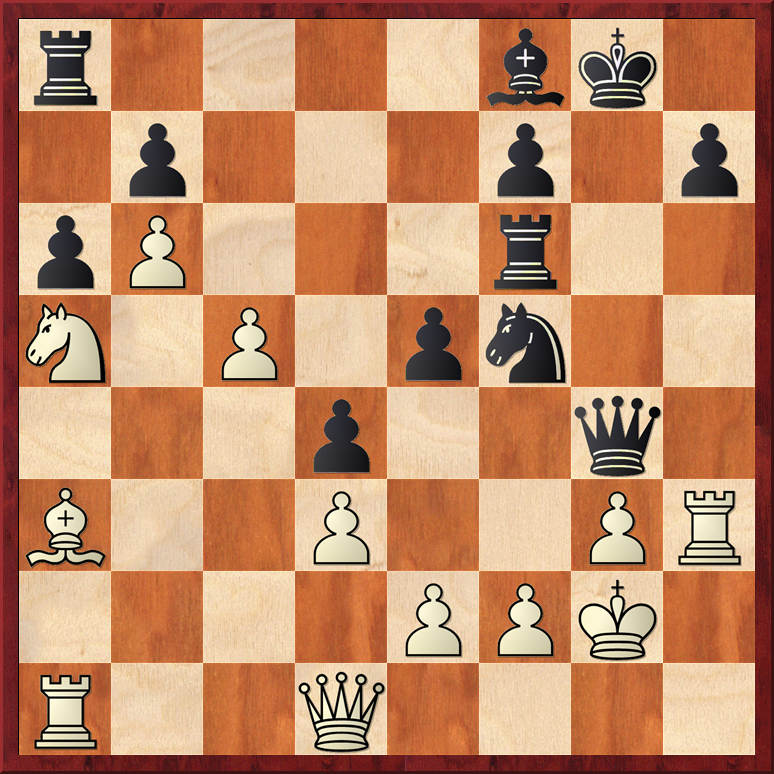
21. ... g5! (D)


This strong move caught me completely by surprise - I have actually noticed that I often miss these sorts of pawn moves which allow a lateral major piece maneuver. In fact, I do miss lateral major piece maneuvers in general more frequently than I should...

Luckily, I am still in control and with some accurate moves I could defend against the attack. The queenside battle is still won - b7 can be captured at any moment. 22.Kg2 g4 23.Rh1 Nf6 24.Nxf6+ Rxf6 25.h4 gxh3+ 26.Rxh3 Qg4? (D) (26. ... Qg6 would have kept the game going)


It is now my opponent's turn to overlook an important detail. 27.e4! This tactical pattern is also commonly overlooked, even by strong players. Black must either sacrifice a piece for a futile attack, or trade queens and lose the b7 pawn. Understandably, he chose the former, and the rest was fairly easy, even in mild time pressure (after this move I had 6 minutes left to his 13).

27. ... Ne3+ 28.fxe3 Rf2+ 29.Kxf2 Qxh3 30.Qh1 dxe3+ 31.Ke2 Qd7 32.c6 Qd4 33.cxb7 Rd8 34.Qb1 Qd7 35.Bxf8 Qg4+ 36.Kxe3 Qxg3+ 37.Kd2 Qf2+ 38.Kc3 Qd4+ 39.Kb3 Kxf8 (39. ... Qxb6+ 40.Bb4) 40.Nc4 Qd7 41.Ra5 Qxb7 42.Rxe5 Qc6 43.Kc2 Rd4 44.Qb4+ Kg7 45.Qc3 Qa4+ 46.Kc1 1-0

Another instructive game, with plenty to be learned from the opening. Perhaps next time I will look at another game of mine from this event.